To love and leave home in search of the self
Responding to Arcana at the Edinburgh Festival Fringe 2026
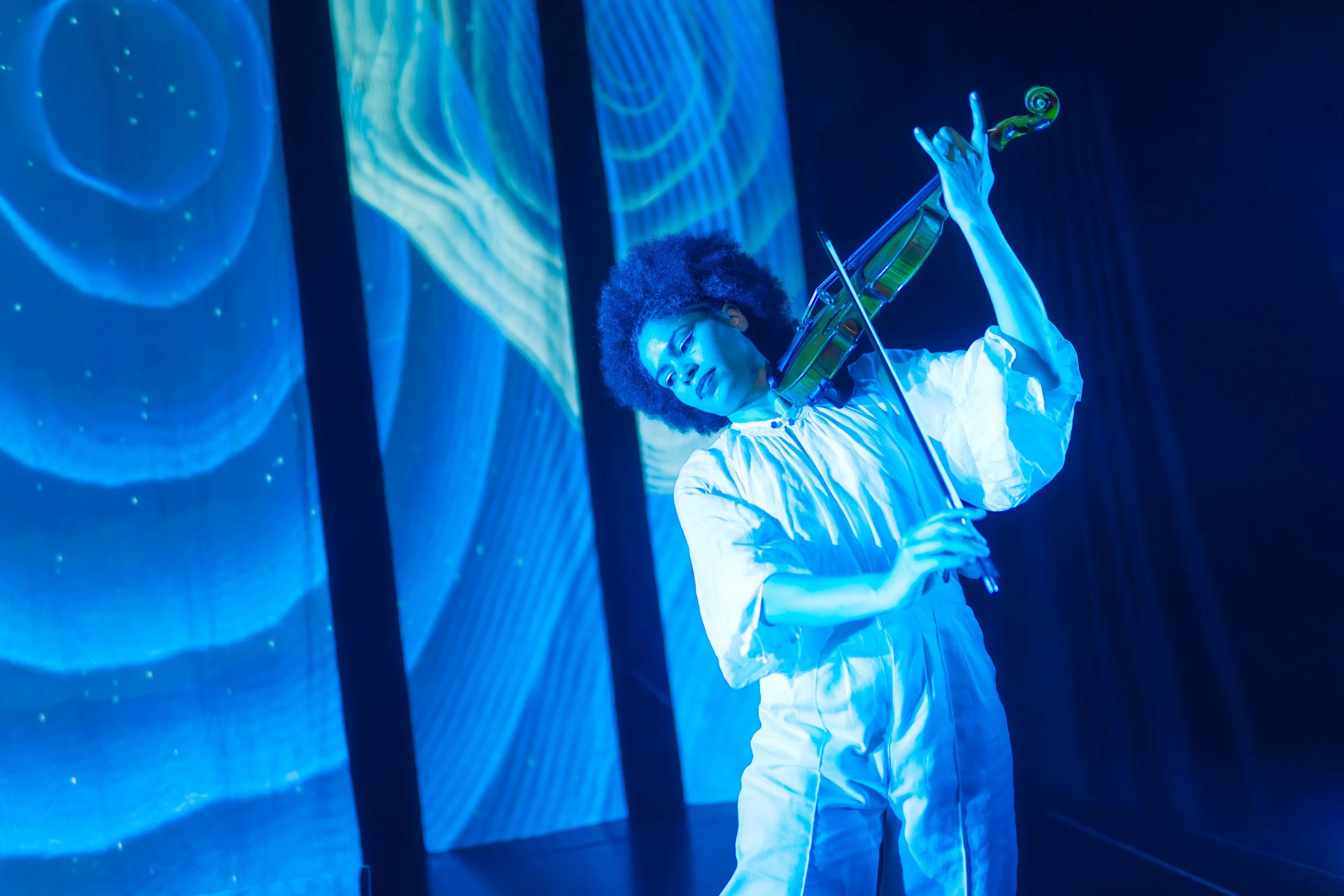
Fay Guiffo in Arcana | Photography by Mihaela Bodlovic
Arcana is a poetic, music-led hero's quest by the French Cameroonian musician, performer, director and educator, Fay Guiffo. I see the theatre piece on the day it opens at the Assembly Roxy on Roxburgh Place. Outside, rainclouds ride low over the converted church. Inside, it’s dim. A few faint lights pick out a slim, still figure, who seems pressed down by the height of vaulted ceilings.
For the first moments of the piece, my eyes strain to penetrate the darkness. There are drum-like martial beats, and the tramping of massed troops. English and French interweave with the Ghomala’ language of Ekondo. The deep gloom is broken in intervals by pulsing filaments of coloured light. It feels dream-like.
Guiffo plays the rebellious sixteen-year-old apprentice musician, Arcana. She’s in conflict with two important symbolic figures: the Master Musician whom Arcana wishes to be like, and the Emperor, her father whom she loves. Arcana looks steeply upwards, and I imagine a giant figure looking down on her. I understand the natural temptation to align oneself with both power and love; in my life these two forces are often twinned.
We find out Arcana has just taken final exams to become a Master Musician. The setting and the history of the building go along with the narrative. In a previous life, the Assembly Roxy used to be an examination hall where generations of students were put to the test. God must be the ultimate monitor. Much of my own Cameroonian childhood was spent in the stark, stonework churches seeded by Scottish Protestants along West Africa’s Atlantic coast. Among them were Mungo Park and David Livingstone, known in Scottish history as light-bringers rather than as agents of Empire. Christianity was one of David Livingstone’s “three C’s” along with commerce and civilisation. In our home congregation, we had at least one Mungo and countless Davids.
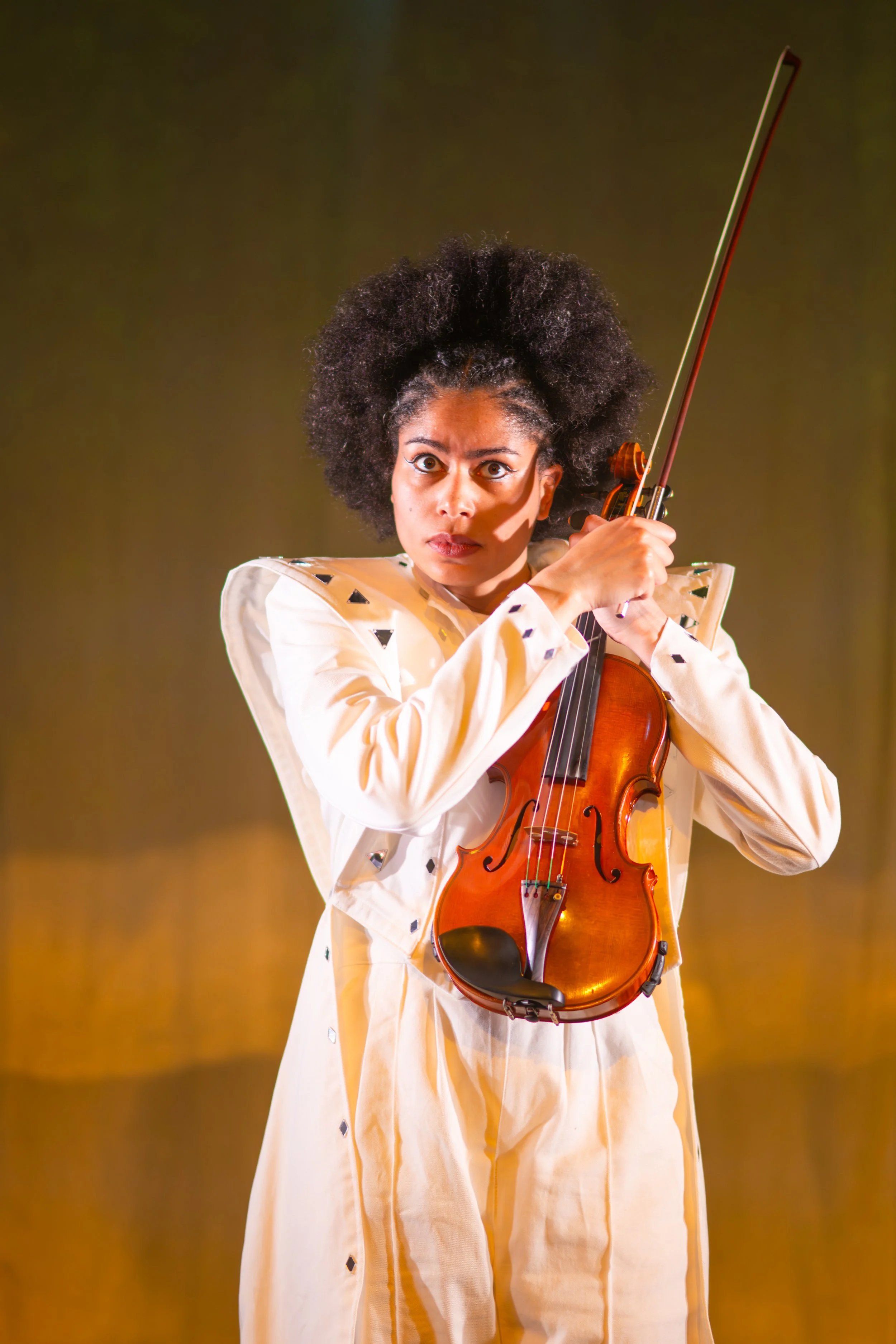
Arcana at the Edinburgh Fringe | Photography by Mihaela Bodlovic
As a poet and process-oriented somatic therapist, I have been trained to treat therapy and poetry as expressive, embodied and deeply creative practices. I notice how the bare stage is populated by Guiffo’s imagination. She brings together the separate sensory channels of vision, sound, movement and feeling into a contemporary story which helps me to connect to my "deepest self". The minimal gestures by which the cast of characters is sketched out give the performance a mythic feel. I notice a random burst of joy bloom inside me when the music loses its regularity and begins to tiptoe about the stage. I find the sudden shift into playfulness delightful. The discipline on the performer’s body breaks, allowing it to move in unregimented ways. At least, this is the first meaning I make from what I observe. Later on, I think about how a performer’s body is also their instrument which they control to communicate with the audience.
Arcana reminds me of my own rebellion in leaving my home country at sixteen. At the time when I grew up, the word ‘adultism’ had not yet been coined to describe relationships where adults held all decision-making power over children. My parents were strict and loving, but our town had a distinctly evangelical spirit. The congregations were policed by prying eyes and wagging tongues. Adults were warm but they tolerated no back-chat from children. After my final exams, Glasgow seemed far away enough from a situation where I felt unable to be myself. My parents didn’t want me to leave. We wrote each month. Still, the ties between us loosened over time and distance. Much later, as a single parent, I would also face questions of how I used my power over the small humans in my care.
Both therapy and art explore the boundary between the self and what is outside the self. From an infant’s point of view, their caregiver is all-powerful. First the infant perceives the adult as a part of their own body. Gradually the child learns that the caregiver is a separate person. The child realises where the border between self and world is drawn. The child knows what is “me” and what is “not-me”. They come to understand the role of ‘others,’ in relation to themselves.
Arcana’s desire to be herself and her longing to remain connected to loved ones are both natural. Moments when we are asked to comply with authority, or when we must defend our unique vision, can rupture our connections to those we value. Arcana’s break with her ‘fathers’ is the price of her care for the oppressed population of Ekondo. However, separation can also open us up to a wider, more communal sense of self. When I chose to leave home, I assumed I’d find new collectives which would embrace me with the easy recognition I’d taken for granted at home. That hasn’t happened. Instead, I found a certain amount of freedom. I’ve realised that being in community is more of a practice I can cultivate than a gift which I expect to receive.
Guiffo says in a 2026 interview: “I entered the classical music institution wanting to follow its rules, until I realised what I was sacrificing by silencing my own voice – and began the journey of finding it again.” Sometimes I think about how shade is used as a metaphor in contrast to brightness. Although there are bursts of colour, many of the lighting states in Arcana are dark. In the absence of light, sounds come into focus; the live violin, the recorded music, how the audience sings a response to Guiffo’s cue. In her book ‘Opening to Darkness’, the Zen monk Zenju Earthlyn Manuel writes of the dark as a sacred space. I think about Guiffo rediscovering her own voice, and her vision coming to fruition.
Arcana was performed at the Edinburgh Festival Fringe from the 17 — 31 August 2026.
This Response was narrated by Jess Brough, with sound editing by Sarya Wu.