The Body Politic: Somatics and crossings in Border Bodies
Responding to Border Bodies at the Edinburgh Festival Fringe 2026
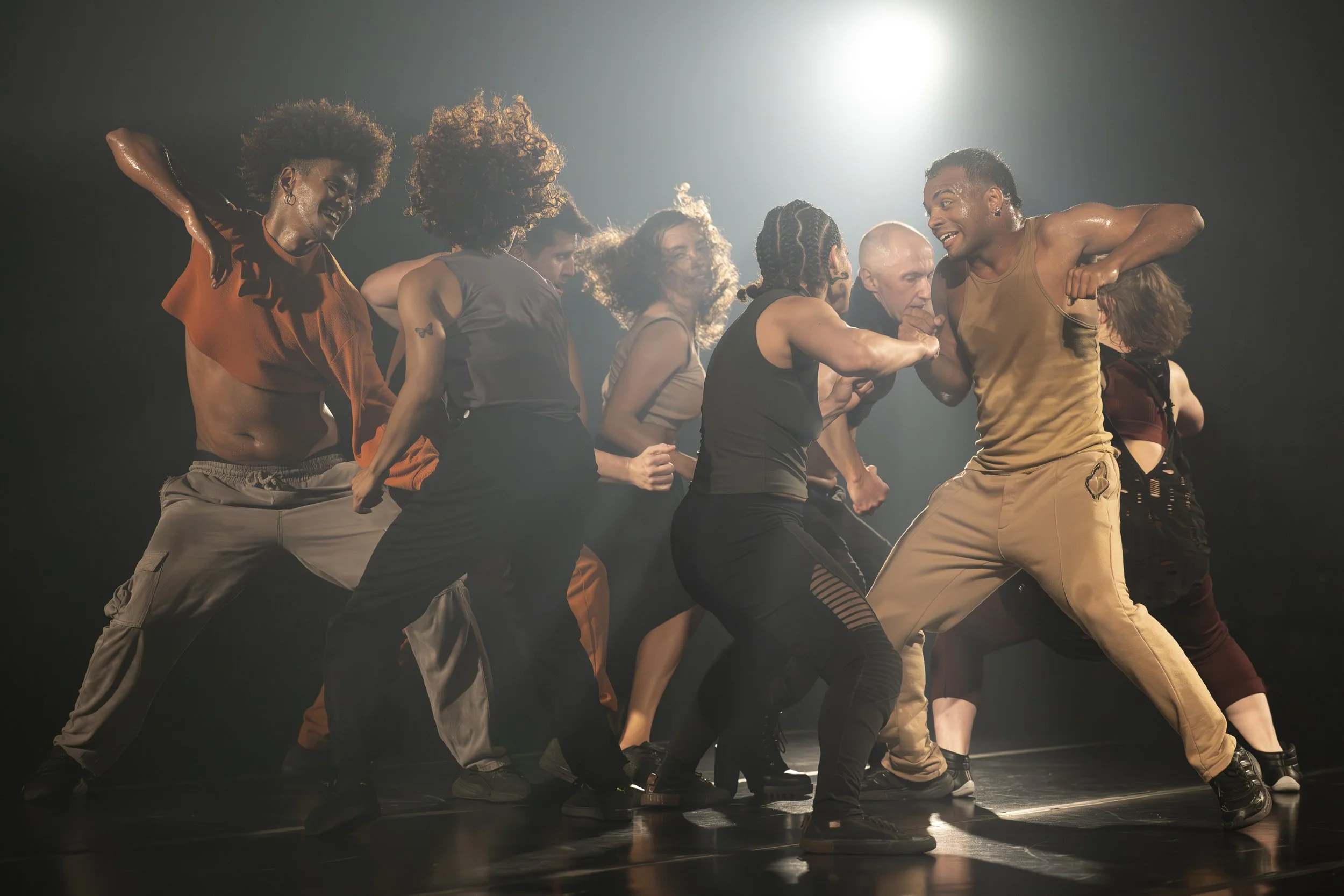
Border Bodies at the Edinburgh Fringe | Photography by Adriano Escanhuela
To start, there is print material. Four options, laid out on a small table, for Border Bodies, presented by T.F. Cia de Dança, as part of the São Paulo Showcase. Take only two, I decide – nice print but they will be at the bottom of my bag, soon, and it is good to not be wasteful. Take only what we need, and can. In my hand, I hold them close and they slip slip spin slip upon each other. New.
Border Bodies is a dance and so I am thinking about physicality and its bodies, how bodies meet and re-meet the world we exist in. I look up the word ‘somatic’; I am unsure of its meaning, although I use it often. It refers to the body, to an effect upon the body. I think: press my palm into the bottom of my chin, fold four fingers against my lips. Somatic.
We walk in and the dancers are already there. Seven, standing. For one hour, they will experiment with hierarchies and their connections to one another; ask how bodies meet one another, beyond identity; move to and from one another. For now they stand still. And then the lights go down and it begins. They remain almost still. Only tense, twitch, turn – a little. They do not seem concerned with each other or each other’s bodies. They do not synchronise themselves: disparate movements, only. And then, they cannot help it. A beat lifts and they are facing one another and delighted by it. The synchronicity of dance begins: the intoxication of its movement.
Soon, an ache starts, along the right side of my neck; roll my shoulders, stretch my neck to the right. I am watching too closely. Held too still. I do not think of it often: how art demands a body. It has a physicality and so it requires a physical receiver. I watch Border Bodies and it calls upon my body – its receiver – loudly.
The first dancer’s inhale arrives and it is a shock - electric, almost - up my sternum. Loud and sudden and needed. The others follow soon and it is less of a shock when they do. I want to inhale, too; do not want the border to exist. Do not want a border between them and us, between audience and artist, between one nation-state and another and another and another. Often, the performers reach for each other longingly, then they are thrown apart: an unseen border is in place and they cannot be with one another because of it. The rhythm starts to build, then loses itself. Frantic, frenetic. Somatic: I can only understand Border Bodies through its somatics. How the bodies move and – with that movement – move something in me, too. Bodies thrust and lunge, circling one another. Jumping with one arm, two arms, in the air. The performers of Border Bodies are very sweaty, and I feel the heat, too. Their hair sticks to their faces. One seat over, someone holds a folding fan. The dancers do not feel its give, although I do, and it is a relief.
Then, they walk on top of each other. One body stretches over another and holds up another, and another twists and bends. Soon, I feel Border Bodies across my cheeks: a light fizzing spreads, and it is a sensation I experience rarely but often enough to understand that when it arrives – sparkly, cool – the art is good. Movement on stage is felt as movement in the body, as it watches/I watch. To end, they are shaking, hard, and my arms are loud. Somatic, I think, this is somatic. After, we clap and the dancers crouch low. Stamp on the floor and their feet arrive in my thighs. Thud thud thud into muscle and bone. Fat, too. The audience joins in.
Thud thud thud.
An applause is not enough for Border Bodies; they’d like us to feel it, like this.
Thud thud thud.
—
We – the audience, one body and many bodies – leave. Piss, then return to crowds.
August narrows the streets here. Too many bodies.
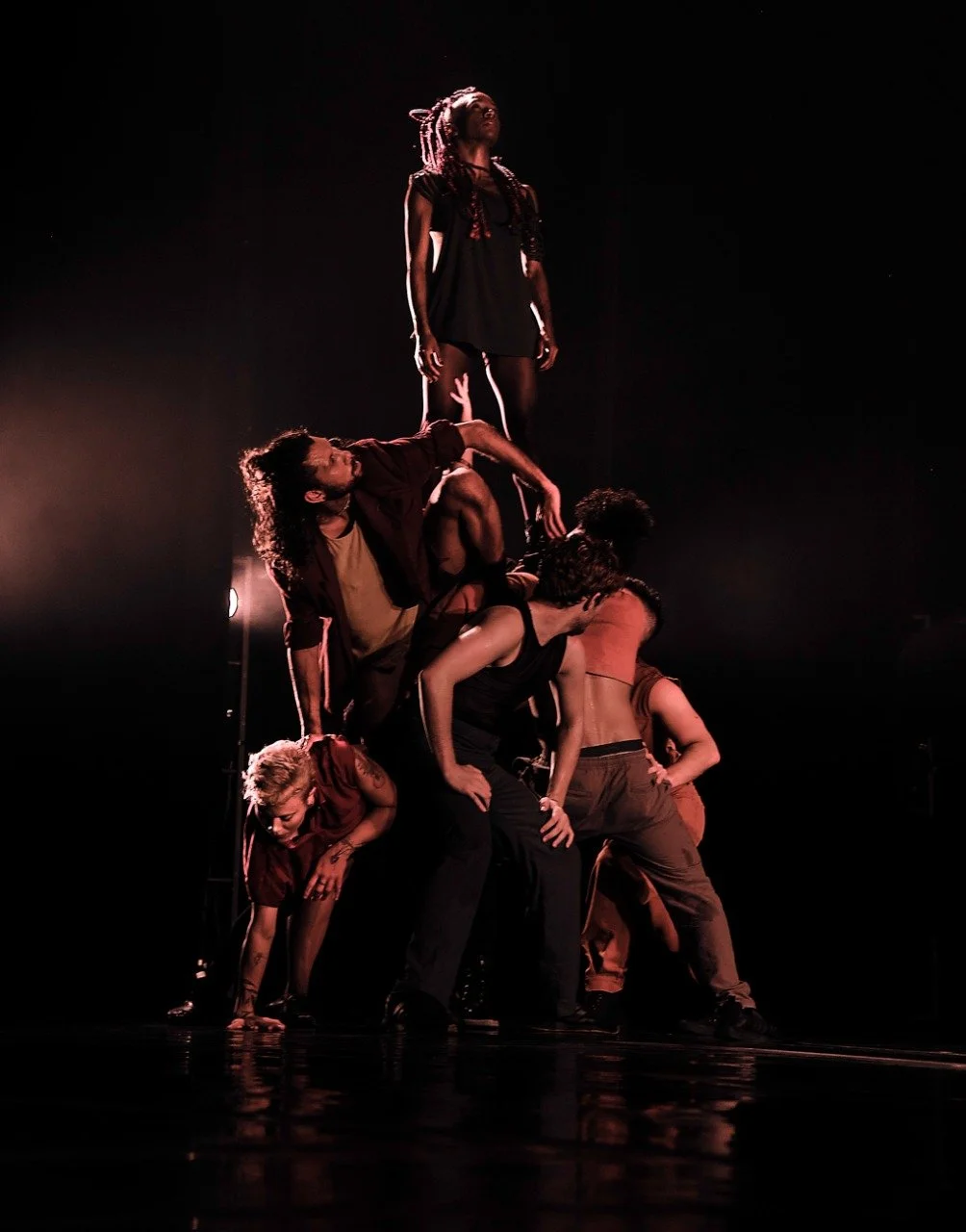
Border Bodies at the Edinburgh Fringe | Photography by João Benz
Sore, and so I think of the dancers, their bodies after Border Bodies. How they stretch. Knead at their muscles. Place an ice pack on an ankle. They sleep each night in one of Edinburgh’s many rented beds, and it is never for long enough. It is difficult to know the bodies of others; to cross the borders of others’ bodies. Border Bodies attempts to cross them and its failure to do so is its raison d'être. It is not possible to fully become one with another, but we want to – Border Bodies wants to – and the desire to be one, despite all the hierarchies that keep us apart, is beautiful. It is not possible to cross the border of one body to another, which is why we ought to try.
Later, another show. A front of house worker asks a person in the queue to stand closer to me. Just there, thank you, closer, closer. If that’s alright. Thank you. So near, we cannot turn ourselves or sip our drinks - in case we touch one another. In the next day’s first queue, my heart beats too fast. There are many bodies, with many places to be. Consider the body politic of a performing arts festival and decide not to consider it, yet consider it still. A performing arts festival demands bodies – audiences, artists, organisers – and, with them, it becomes a body politic. One body, made up of many. It is troubling to know that the head – the heads – of this body politic do not always care for the limbs, although I am not yet sure who the limbs are, where they rest.
Soon, I am sat, again. Another show. Hard seats, close seats. Beside me, a man is laughing. His shoulders: up down, up down. My shoulders, then: up down, up down. It is like Border Bodies: how one dancer starts to jump and then another, and another. Some art is that commanding, demanding; we experience it all together, as if we are one, and it is as if the borders between us do not exist. Unsure, with Border Bodies, where our borders start and end.
Six shows in two days is not a lot. And yet, the body’s borders give way. Eyes sting, a little, and it is commonplace. Too much typing - quick reviews, emails. Bright lights, they splinter with astigmatism. Drink only a little water; bathroom queues are long. Not much sleep. And not quite hunger, but a close and hollow cousin of hunger. Streets only spin on occasion.
Art demands a body. Many bodies, actually. And the bodies become hungry and sore and tired. They do not care for the world’s largest performing arts festival. But the bodies are delighted, too. Thrilled. It is the world’s largest performing arts festival! The bodies cannot maintain a border, not really. Not with anything and not with art, like this. Somatic. The border is there to be crossed.
Border Bodies was performed at the Edinburgh Festival Fringe from the 7 — 30 August 2026.
This Response was narrated by Jess Brough, with sound editing by Sarya Wu.