Drinking piss and refusing the theatre of representation
A Response to FORIEGNER at the Edinburgh Festival Fringe 2026
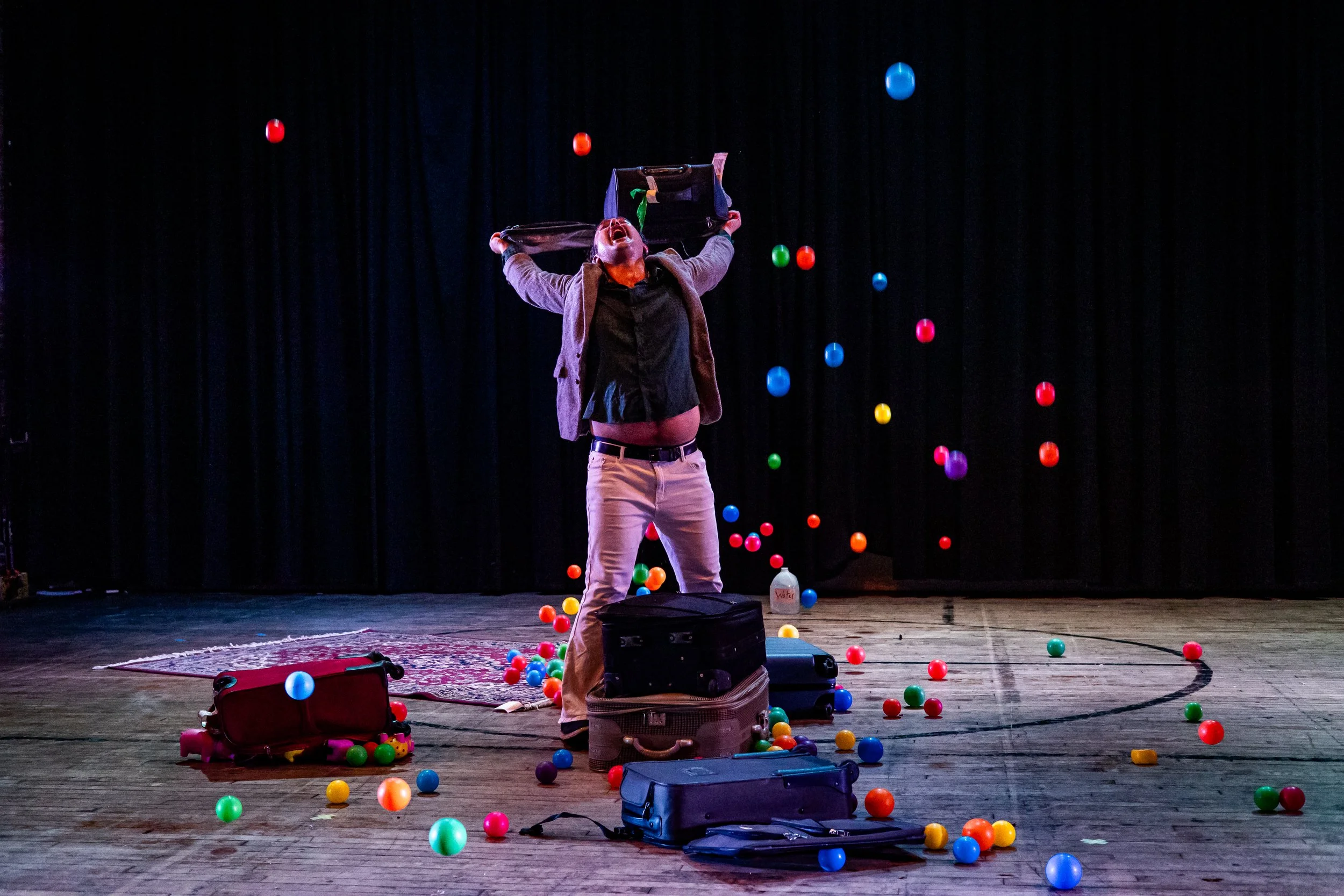
Sohrab Haghverdi in FORIEGNER at the Edinburgh Fringe 2026 | Photography by Darien Griffin
For years, I have wanted to write an essay on how the closing credit cards that come up at the end of biopics always make me cry. You know the ones. “Turing’s work inspired generations of research” from The Imitation Game. “That same year, John and June were married and settled into the lake house” from Walk the Line. “Frank and Carl remain close friends until this day” from Catch Me If You Can. Countless films and every time, even at my most Prozac-sedated, I well up as if on Pavlovian cue. They cast a spell over me: a promise of teleology, of narrative, of clarity. You have to understand what has happened to someone in order to sum up their life. You have to understand what has happened to yourself.
One ex, two therapists and innumerable posts courtesy of my Pinterest algorithm have suggested I need too much to understand things, and that it might be getting in the way of my peace in the world. Certainty, they have told me, is not what makes us feel safe; rather, it is a disinterest in certainty. Still, against their good advice, I long for understanding. I want to look at my life and be able to envisage the end credits. I want it to make sense, and for my own being to make sense – to be legible to myself and others in some kind of way. It was Kant who originally said to know thyself. I have been trying to do that for 35 years.
It is useless to pretend that I did not walk into FORIEGNER (deliberately misspelt) already thinking about its ending – hoping to understand it, and myself, in a genuinely transcendental way. I went in with a notebook and a preternaturally formed attachment to the show, in the same way I have walked into every Iranian film, play and restaurant since I was a child. I do this despite sincerely believing that representation politics are part of a neoliberal strategy to placate rather than change, reform rather than dismantle and start anew. But when Summerhall programmes FORIEGNER – Iranian clown Sohrab Haghverdi’s show about the American asylum process – I am sat. I have very little connection to my homeland, or really my parents’ homeland, beyond my name, very shaky Farsi and a constant unsettled ache. Walking into a show like this can sometimes feel like the closest thing I will probably ever have to setting foot on the land itself.

Sohrab Haghverdi in FORIEGNER | Photography by Darien Griffin
FORIEGNER was, bluntly put, entirely the wrong show on which to place these expectations, and for that I admire it hugely. Haghverdi is an Iranian clown, and FORIEGNER is a show about his asylum process: it is also a refusal to be legible, categorisable or palatable in any way. The show’s narrative throughline, such as it is, revolves entirely around Haghverdi gearing up to drink his own urine on stage so that the US government will be impressed enough by his avant-garde credentials to grant him an artist’s visa. In one scene he swathes himself in a Persian carpet and yells. In another he coughs for a solid five minutes, as the audience around him fidgets. Is the urine real urine? Is the carpet truly Persian? Is he actually choking on stage? There is a very real moment where we worry he might be. At its core, FORIEGNER is concerned with the presentation of authenticity that representation politics demands. To be a marginalised performer on stage, or a marginalised person in the world struggling to stake out your place, often asks us to know who we are, and to proclaim it in loud and determined ways. What happens, FORIEGNER asks, to the complexities of the human experience – its uncertainties and liminalities and ambivalences – when our lives become a series of DEI committees demanding a constant performance of the self?
The number of shows about Iran in this year’s Fringe is – based on my anecdotal experience of eight years of festival attendance – unprecedented. This is unsurprising; there is nothing quite like the West bombing a country to pieces to give it sudden prominence in the arts and culture sector. In this year of grief, I do not blame myself for seeking some sense of collectivity and belonging, but I am also grateful to Haghverdi for refusing to give it. FORIEGNER is an exercise in the value of discomfort: halfway through, following an onslaught of scatological bits, Haghverdi breaks character and screams against the Islamic Republic and in support of Trump’s war as a liberatory force, which makes the white audience squirm and my heart sink. Even this is eventually revealed to be more complicated than it first appears, but that isn’t the point: the point is our collective reaction. The Western tradition has long seen theatre as a means of facilitating catharsis: we build empathy with what is taking place on stage in order to achieve an emotional release. What happens when the theatre we see has no interest in making us feel better, or aligning itself with us in any way? How do we feel? Outraged? Alienated? Betrayed? Why did we expect to feel comforted in the first place?
Kant said to know thyself. Haghverdi turns to another philosopher, mystic poet Rumi, who said we should kill ourselves instead; that is to say, we should kill the certainty of our ego to allow for growth. We cannot be of help to ourselves or others, Haghverdi argues, if we hold tight to our made-up idea of who we are. I am not sure how to kill the part of myself that already feels so tenuous and fragmented – that already feels barely of anywhere, or belonging to anyone. Still, FORIEGNER’s urge to do so might be the freest I have felt in a long time. It is a way of existing in the world that eschews understanding, refuses the end credits that tie everything off neatly. I want to know what would happen if I let go of this need to make sense. I want to know what the death of that part of me would allow.
FORIEGNER was performed at the Edinburgh Festival Fringe from the 5 — 31 August 2026.
This Response was narrated and sound edited by Sarya Wu.