How do you write about America?
Responding to Angela Flournoy and Claudia Rankine at the Edinburgh International Book Festival 2026
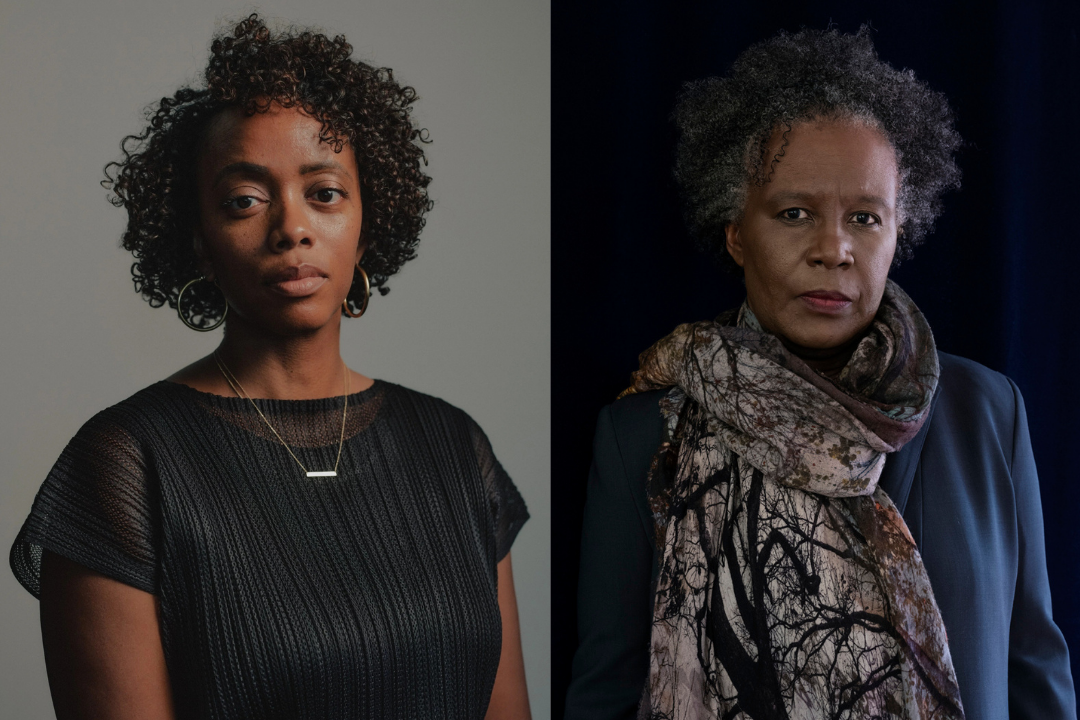
Angela Flournoy photographed by Miranda Barnes; Claudia Rankine photographed by Tanya Marcuse
Taking a front row seat at a book event feels exposing,
maybe even a touch confrontational.
But I am a short arse, and I have learnt: if a seat is free at the front, take it
or regret it later.
One day I will make a plea for seating events by height, but that is for another day.
And if I am honest, I want to be as close as I can to this conversation.
I take the seat.
Scan the room for faces of colour and find a few.
Turn my head toward the American voices,
an eager group of white students sitting to my right.
What is it like for them
to hear America discussed from here,
at this moment,
by these Black women?
And I am pulled back to the late 90s, to my university.
Our Amnesty International group had invited civil rights lawyers from Washington
to speak about the systematic racism of the US justice system.
What I remember most
is not their eloquence
but the protest from young white American exchange students
who heckled, then walked out,
furious that these Black American men
would criticise America
and criticise it here.
What did we know?
What did we really know about these men?
I check my watch.
Fifteen minutes early.
I wonder if my response will come mostly from this before moment,
the charged quiet before anything is said,
the atmosphere we carry in with us,
rarely acknowledged.
The title How Do We Write About America?
is a provocation.
It is impossible to attend without bringing your own critique,
your own questions,
because we are asking the same of our own country.
How do we write, think, read, talk about
place, nationhood, belonging, home
in these times?
What do I need from this discussion?
From these women?
Is America the place we look?
A warning?
A forewarning?
Claudia Rankine has been a voice I turn to,
and I sit like a child pressed to the glass,
front row eager for what she will say
to us,
to this moment.
The lights dim.
Lorraine Kelly’s prerecorded welcome fills the room.
We clap.
I notice quickly an exhaustion in Angela Flournoy and Claudia Rankine,
a heaviness that settles across the space.
I find myself wondering
if this discussion is an unreasonable weight,
if it asks too much
of these women,
in this room,
at this moment.
The Chair keeps us close to the books,
a gentle pull away from the provocation of the event’s title,
but the nature of their work refuses containment.
Briefly,
the touchpaper lights…
Both books centre friendships,
friendships strained as red lines are drawn
and crossed.
The Chair says that has not quite happened here,
and the audience bristles.
The writers say, more than once,
that they do not know what it is like here.
They mention Brexit
and I am struck by how odd it is
that we know America:
its culture, its politics, its history,
so intimately,
and yet we remain
strange to them.
They do not know what it is like here,
and I wonder what would happen
if we could tell them.
White supremacy is felt here too.
The far right rises here too.
Our horror and impotence,
genocide livestreamed onto our phones,
burns a moral hole in us too.
Angela reads.
Her voice soothing,
her images vivid and unsettling.
Class and race intersect.
Morality bends under the pressure
of making a living.
The ability to take a stand
seems directly tied
to the ability to survive.
To act or not act
sits at the heart of both books.
It is the central question, Claudia says.
Do we act, or do we choose not to act?
Her book is also rooted in friendship,
a contemporary Antigone.
One friend who wants to bury the dead,
another who insists we cannot.
We are living with the dead, Claudia says.
And I am struck.
Newly haunted.
It is hard to hear anything else.
But she tells us
that when her students are arrested or expelled,
when police come to her lectures looking for them
for protesting, for speaking,
what else could she write
but a book about what we can
and will not do?
And I am present,
listening,
taking notes,
but honestly,
I never left her words:
We are living with the dead.
We come to events
as we come to reading,
with all we are.
Sometimes a truth stalls us,
stuns us.
Sometimes it passes us by.
Sometimes a conversation,
like art,
electrifies,
leaves a spark
in the body.
We leave.
Go back
into the world,
aflame.
This discussion is not really about
how we write about America
but about how we stay human,
how we exercise our humanity.
This is a time of action, Claudia says.
And then,
it is over.
We clap.
File out.
Fizzing.
Now is a time of action.
What more
was there to hear?
Angela Flournoy and Claudia Rankine appeared at the Edinburgh International Book Festival on 26 August 2026, chaired by Dina Nayeri.
This Response was read by Hannah Lavery, with sound editing by Sarya Wu.