
A cacophony of violence: Sonic occupation and defiance at Leith Theatre
Responding to Zifzafa by Lawrence Abu Hamdan at the Edinburgh Art Festival
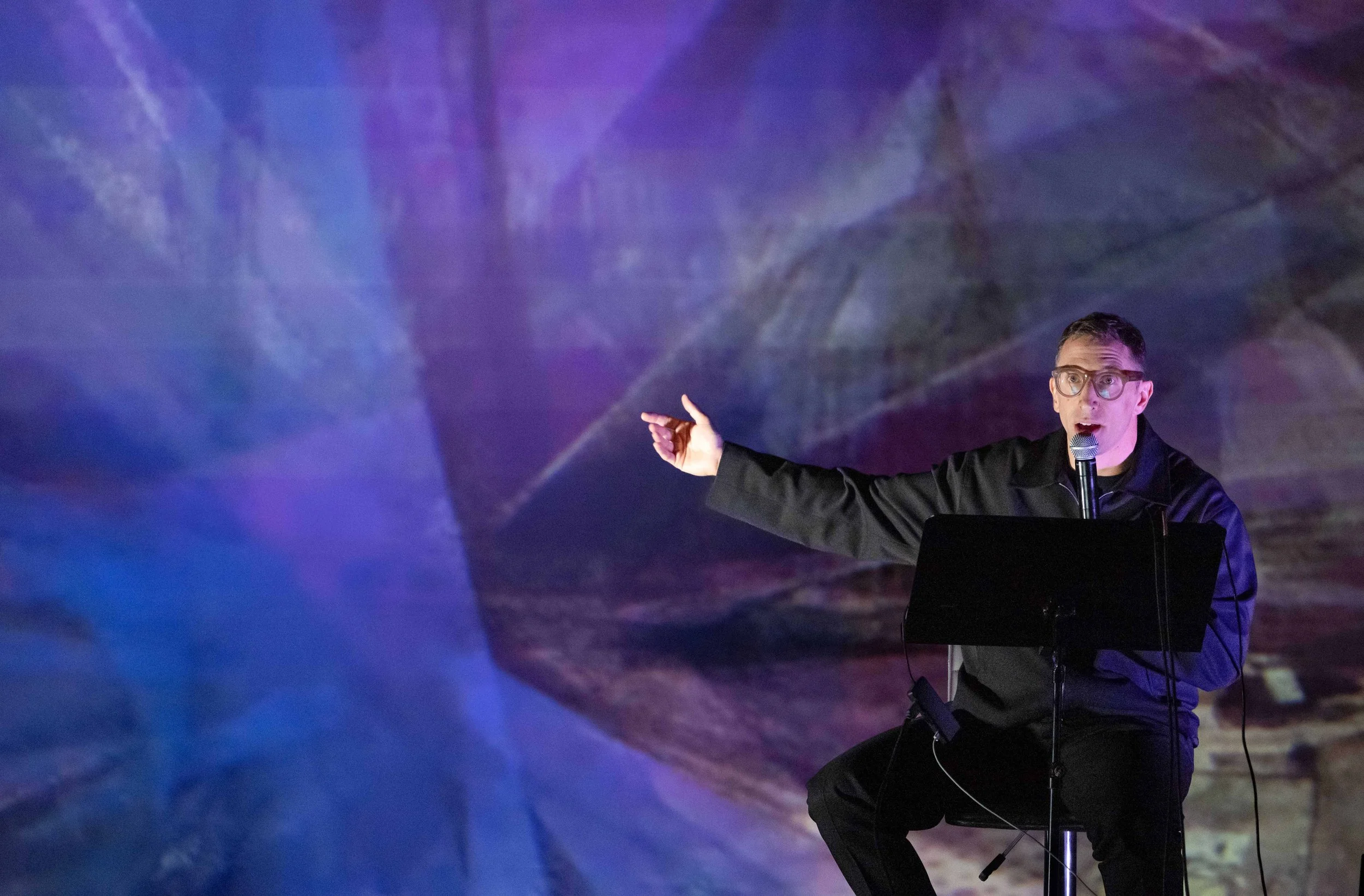
Zifzafa performance by Lawrence Abu Hamdan | Neil Hanna Photography
What do we choose to listen to every day? A year has passed since I stopped taking headphones with me when I leave the house, since I cancelled my Spotify subscription due to the company’s complicity with Israel’s genocidal campaign in Palestine. The music streaming platform’s founder, Daniel Ek, pumped millions of dollars stolen from artists into the German AI military company Helsing, which has active contracts with international arms companies supplying Israel. I hear a lot more now: snatches of people’s conversations as they cross the street; delivery drivers on e-bikes latticing a network of invisibilised labour across the city; girls on the bus asking ChatGPT for romantasy novel recommendations.
Often, though, there is silence. It has been mundanely transformative to reject the lie that this silence must always be filled, to realise how easy it is to claw back at least some time, some presence of mind from the digital quagmire farming our (in)attention for billionaires. In the three years since the genocide in Palestine began, I have been in direct contact with a now eighteen-year-old boy named Mohammed in Gaza. His messages relay the sounds of constant, unrelenting atrocity: “the bombing hasn’t stopped”, “my brothers are crying in fear”, an airstrike that martyred a beloved neighbour, a photo of him in a shroud. In these three years, I have never felt more aware of silence. The way it hangs overhead, a heavy blessing.
On the final day of the Edinburgh Art Festival, I am here to listen closely. Lawrence Abu Hamdan’s performance lecture Zifzafa is named for one of many Arabic words for wind: the kind that “shakes and rattles all in its path”, he tells us. Zifzafa, Abu Hamdan’s most recent body of work as a self-described ‘private ear’, consists of an audiovisual piece, a video game simulation built in Unreal Engine, and a live performance. It presents a sound-led investigation into Israel’s proposal to build 31 of the world’s largest land-based wind turbines in the occupied Syrian Golan Heights, or Jawlan. On stage at Leith Theatre are Abu Hamdan, musician Amr Mdah, and researcher Renate Lurdesa Baumane; we later learn that a fourth collaborator on the project, Busher Kanj Abu Saleh, was denied a visa to enter the UK.
The three performers sit in front of a large screen. Abu Hamdan narrates; Mdah plays saxophone melodies that melt like dizziness, like vertigo. Baumane faces the screen at an angle, piloting us through a virtual rendering of Jawlan with a video game controller. Wind turbines, Abu Hamdan suggests, have become soothing images in the face of escalating climate breakdown. In the rotation of their blades we find the “sweet sounds of our decarbonised future”. But have we heard what they actually sound like?
The turbines roar into mechanised, simulated life. Noise fills Leith Theatre, a great, inflatable balloon expanding to press against the walls. I feel my heart beat, suddenly rabbit-like in its physiological response to this oppressive sound, and I am reminded that all sound is air that is moving, molecules hurtling into each other in space. I am reminded, too, that the night before, fear had momentarily frozen my body during a practice flyover for the Edinburgh Military Tattoo. It must have lasted for ten seconds at most and I knew what it was, and yet, I hate this hate this hate this make it stop. A life totally colonised by the weaponisation of noise – from the abject terror of imminent airstrikes in Gaza to Israel’s psychologically torturous violations of Lebanese airspace which Abu Hamdan investigated in his 2024 film, A Diary of a Sky – is unimaginable to me. It is an intolerable, depraved cruelty towards body and mind I cannot fathom.
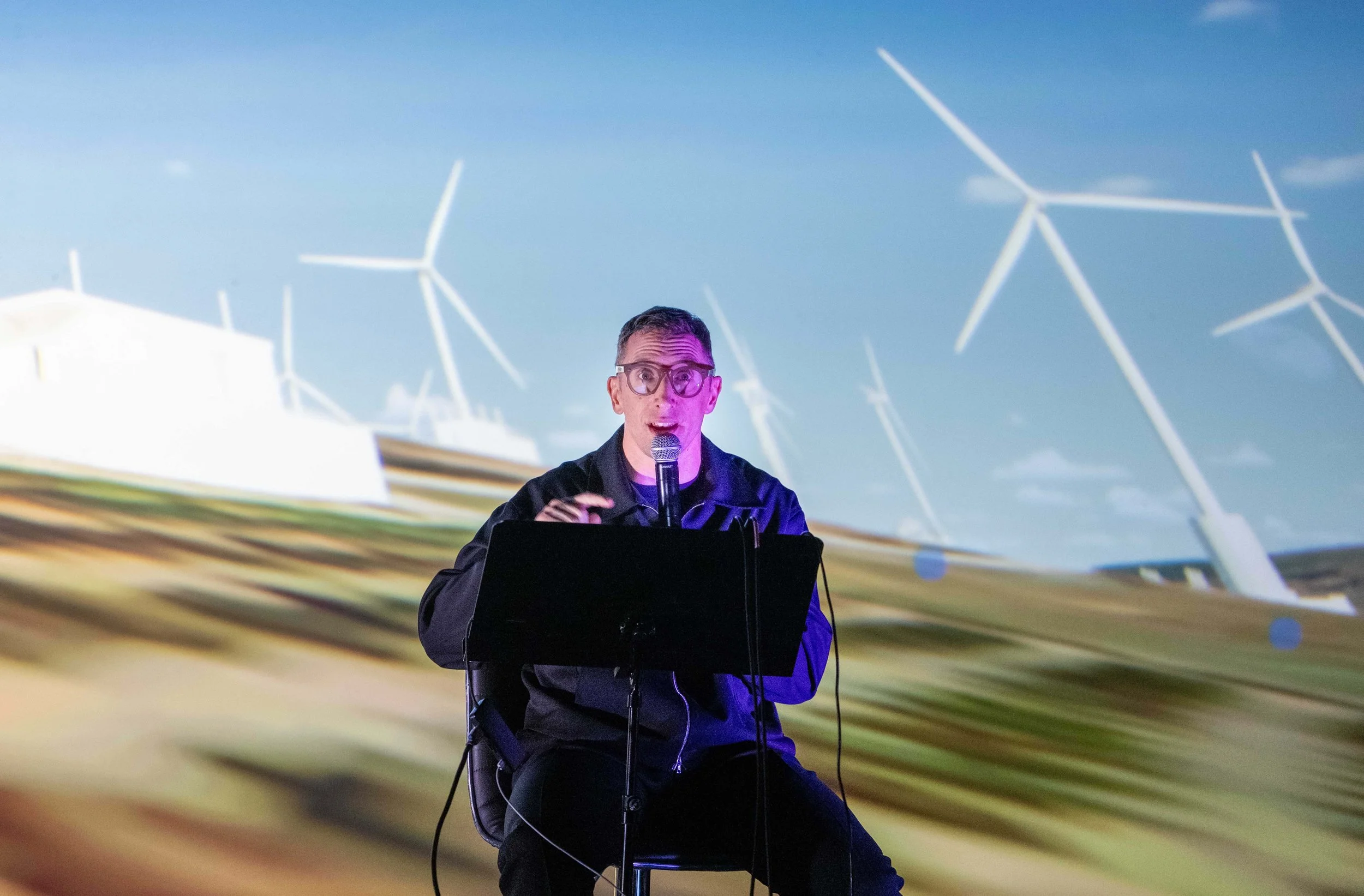
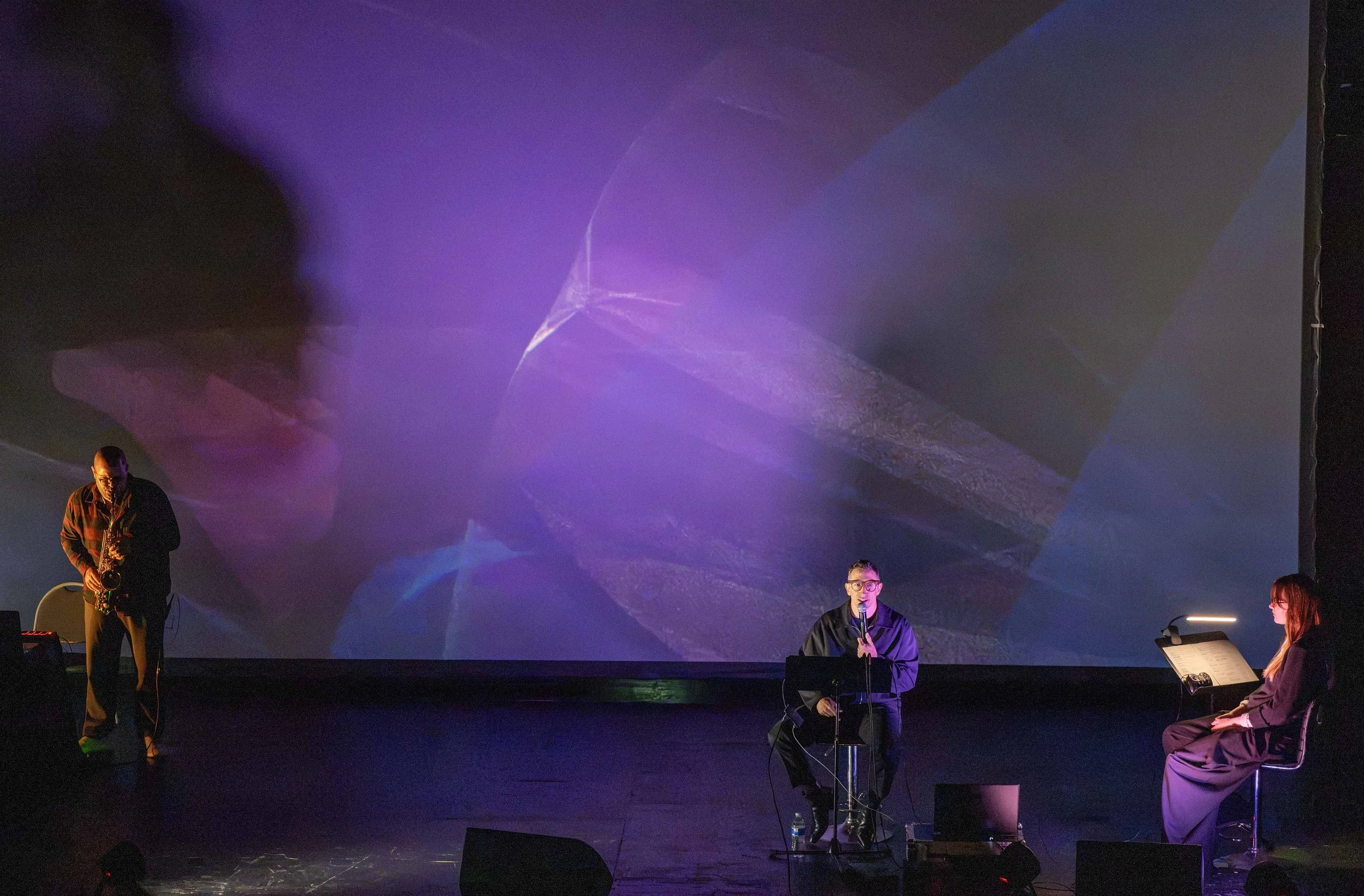
Lawrence Abu Hamdan in Zifzafa (top); Abu Hamdan, Amr Mdah and Renate Lurdesa Baumane in Zifzafa (bottom) | | Neil Hanna Photography
The 31 wind turbines that the settler colonial entity known as Israel has proposed on occupied Jawlani land would generate only 0.6% of its energy needs. (Lest we forget, the settler colonial entity known as Israel is a signatory of the Paris Climate Accords! Lest we forget, the settler colonial entity known as Israel has spewed an estimated 33 million tonnes of carbon dioxide into the atmosphere during its genocidal campaign in Gaza!). These are not benign windmills, but rather a new frontier for exercising domination, this time over sound. Far surpassing their physical real estate, Abu Hamdan explains, the “acoustic footprint” of these turbines is a space-effective way to occupy, colonise, and rip through past and present social fabric. They would exist to both erase the silence that bears testimony to Israel’s displacement of hundreds of thousands of Syrians from their land, and to drown out new attempts to reclaim it.
I am furiously writing in my notebook. The person next to me is chewing gum and texting, occasionally stopping to take photos of the performance before swiping back onto WhatsApp. When Abu Hamdan says something revelatory – that “listening is social and happens between subjects” – I find myself hoping they are listening, at least for this bit. Deciding to listen comes with a burden: suddenly, the world becomes legible as a network of interconnected violence, from the buzz of a text to pickaxes clanging in cobalt mines in the DRC to the eerie quiet on most days outside the arms factory just on our doorstep, here in Edinburgh. And once you hear it, you can’t go back.
Yet Zifzafa also attunes us to how sound is not just the terrain of the colonisers. There is the wind that has carried fertile pyroclastic soil across Syrian land for centuries, nourishing its people. There are folk songs older than ‘Israel’, whose lyrics retain knowledge of a life beyond borders. There is the steady gurgle of the water pumps that even Abu Hamdan admits to, at first, being unmoved by. In the sound of these pumps (nodes of an autonomous water infrastructure built by Jawlanis to combat the theft of their resources by Israel) lies a refusal to be defeated, to confound the oppressor at every turn, to ingeniously slip free of its grasp.
When I get home, I read the ending to the windmill story in Don Quixote, which Zifzafa closes with:
“They were giants, as I told you; but he changed them into windmills so that I should not have the honour of victory. But mind you, Sancho, I will get even with him in the end.”
The enemy shapeshifts, but so does the resistance. If we listen, we can already hear the cracks in Empire’s walls, the weeds strangling its death machines – preparing us for the honour of our victory.
Lawrence Abu Hamdan: Zifzafa took place on 29 August at Leith Theatre, as part of the Edinburgh Art Festival 2026 programme.