Visiting the living archive of Sandra George
Responding to Sandra George: Start from the Level at the City Art Centre
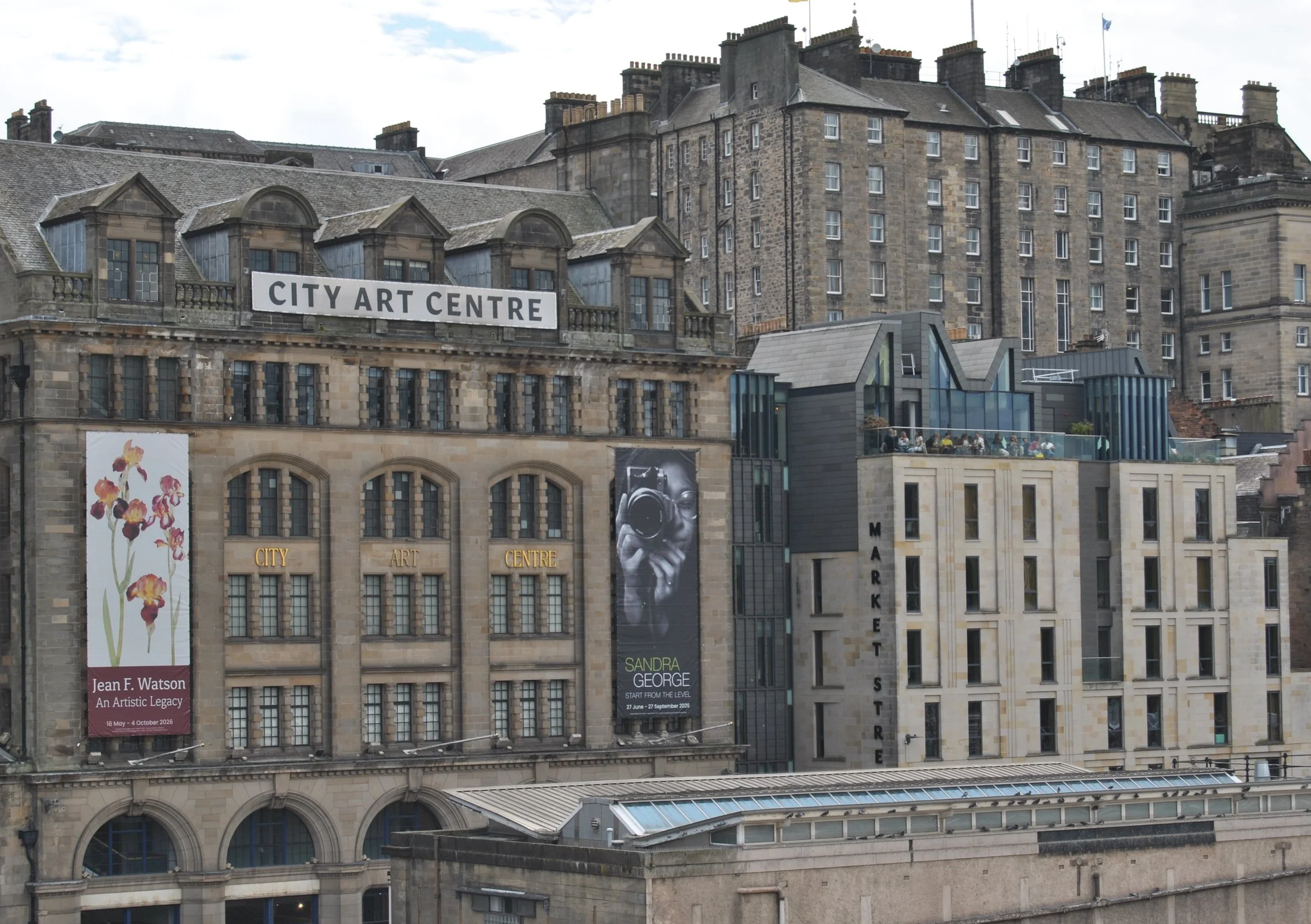
Sandra George’s exhibition advertised on the side of the City Art Centre | Photography by Jess Brough
The scaffolding on North Bridge is finally down and I can see a 40-foot Black woman looking at me through the viewfinder of her camera. It is the advertisement for the exhibition Sandra George: Start from the Level at the City Art Centre. I pause in her giant gaze, a small subject in her line of sight, and offer mine back. I take off my sunglasses and take my own camera from my backpack, resting my arms against the exposed walls of the newly restored bridge. I wonder how many people have walked this way and questioned who she is. How many people saw her face and immediately knew.
Throughout her life as a community arts worker and prolific photojournalist, Sandra (she preferred the use of her first name over her last) did not stop making art, but she died from cancer in 2013, aged 56, before ever exhibiting her work publicly. Her son, Tyler, took great care of the almost 60,000 photographic negatives she had amassed, before entrusting them to custodians Craigmillar Now: an arts and heritage charity based in Edinburgh, the city where Sandra lived and worked for most of her life. Sandra’s photographs are in the process of being sorted and developed by the charity, supported by the continued effort of volunteers and the Craigmillar community who knew her. I find this story of familial and collective care for a woman who dedicated her life to her communities overwhelmingly moving. The exhibition, so clearly, is an act of celebration and love.
Walking into the City Art Centre with my own camera, I feel electric. I have come here with a group of Black artists, educators, and creative practitioners whom I have been fortunate to be in community with for almost a decade, and whose work has helped mould my worldview and my own artistic practice. I will take their photos in this space, focusing on their individual and combined reactions, looking at Sandra through our collective gaze.
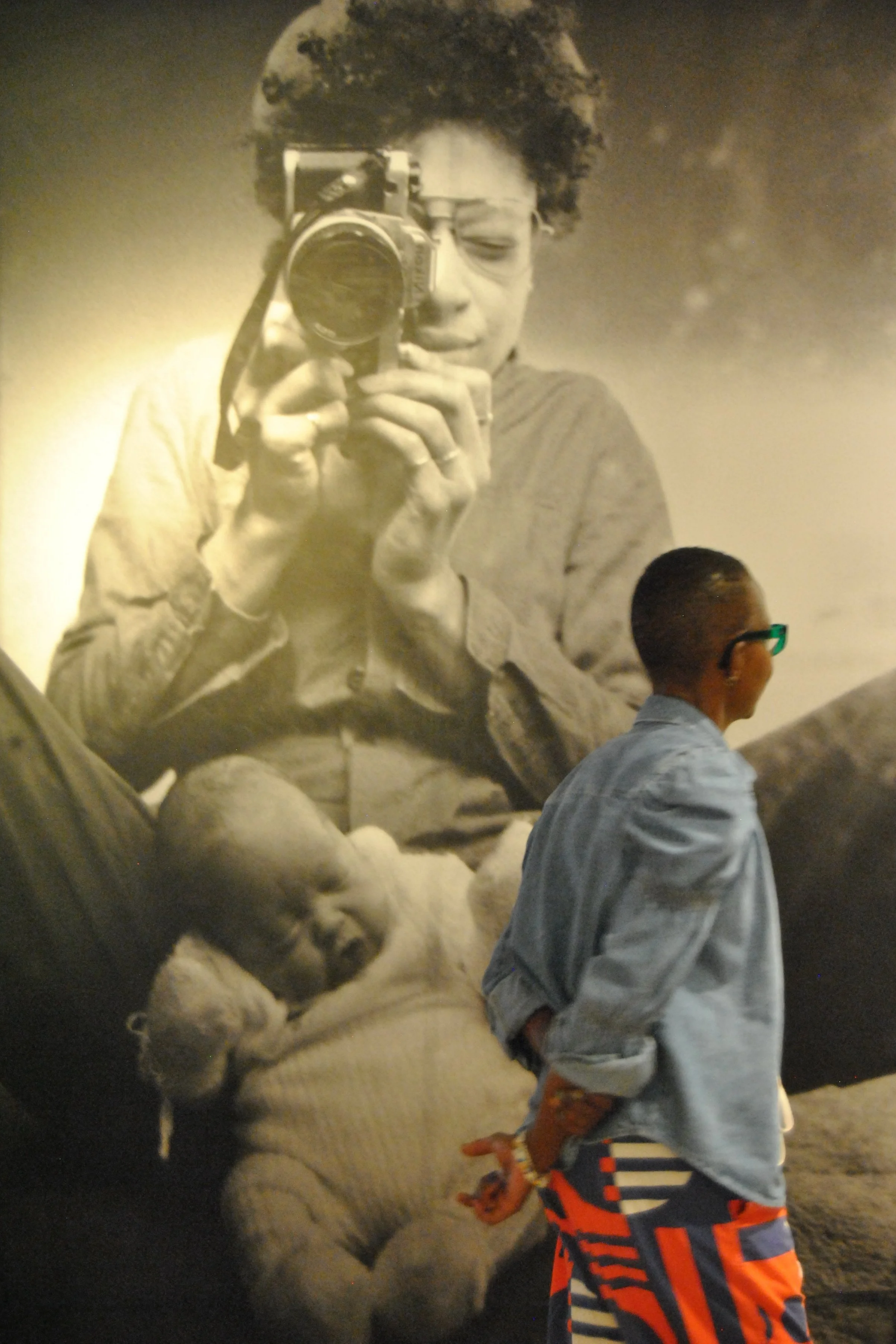
The exhibition, curated by Stuart Fallon and Christian Noelle Charles, showcases 200 works out of the 60,000 and is split into four themes: COMMUNITY, HOME, CHILDHOOD, IDENTITY. When I enter the first room, Sandra is sitting on the floor with Tyler, a baby wrapped in cotton, eyes closed and cooing between her legs. Larger than life again. Okay, I think. That’s new. I had been ruminating defeatedly on parenthood as a strain on art. I had been struggling to see how I could make it work for myself, should my partner and I choose to want it. But here, motherhood is another kind of viewfinder, as Sandra incorporates her child into her practice and raises him as a collaborator. In one image, a newly born and very premature Tyler lies in an ICU ward in black and white, his mother seeing the art in him even then. Or was she making a record while she still could? When she could not know what might come next?
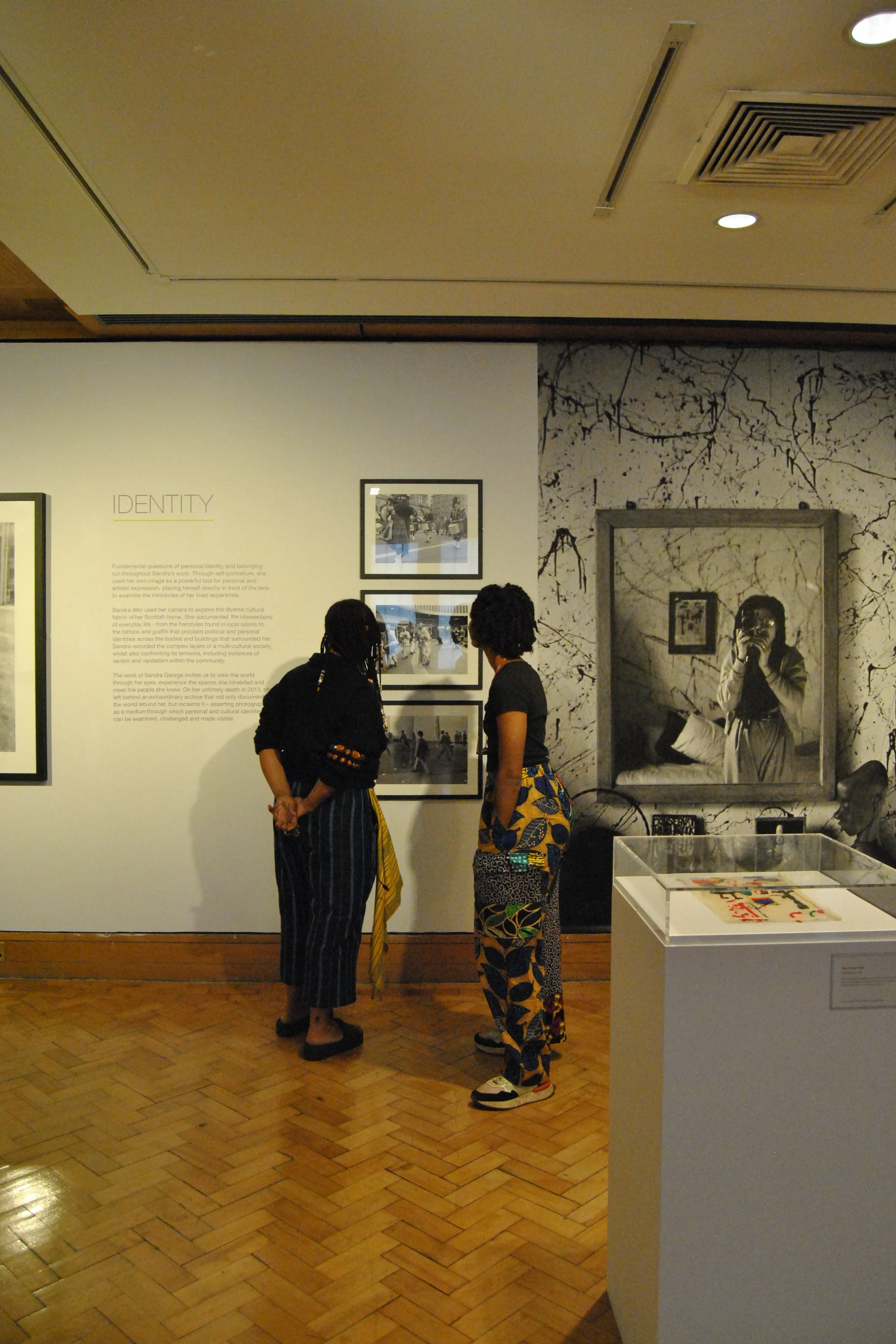
In HOME, baby Tyler sleeps in their apartment beside a gas burner just below the bright light shining in from a window. “Those heaters!” someone exclaims. “They’d burn your house down.” Our group recognises these apartments, these streets, the Education Centre in Wester Hailes, the gym clothes worn by the children in Dumbryden School, the housing blocks and shop fronts in Craigmillar and Dalry. The photographs were taken in the 80s and 90s. Still, their focus on everyday life within community – the activism, the hair salons, the estates – excites us in its familiarity.
Sandra George was always looking. Her artistic work and activism were driven by finding people “at the level [they] are based”, undeterred by adjacency or difference. She took photos of people of all ages, races, abilities and circumstances, working, playing, simply existing. I sense that there was always a point to the images, a declaration that this is a life. I sometimes feel life slipping away from me. Not in the sense that I think I am going to die soon, but in the sense that I can see what is happening in the world – persistent droughts, contagious fires, poisoned waterways. This year there was a part of me that put pressure on myself to enjoy every moment so deeply because I considered it might not happen again. It has been the best year of my life so far, I think. The years are going to get harder, I know.
A week after I attended the exhibition, a much-loved man named Professor Jason Arday was found dead. Across the political spectrum, the British media had hounded him for weeks, publishing 249 articles that questioned his character, his expertise, his childhood, and his humanity. Even though we never met, Professor Arday was so much a part of Black academia that it is almost futile to try to list all the ways in which he touched my life and my experience as a Black academic who once worked in the UK. When I decided to write about Sandra’s exhibition, I knew my thoughts would linger on the archive. Once I heard the news, I could not ignore death demanding to be considered, too. Arday’s work will be preserved in journals and other academic repositories, his life immortalised to an extent in his memoir, which was only weeks away from release before his death. But archives are not a substitute for life.
How much of being an archivist is also being a mortalist or a fatalist? It is a question that stuck with me all through Edinburgh’s festival season, witnessing performances as snapshots of life, carrying my camera in my backpack. Why and for whom do we keep journals, make vlogs, take photos, collect mementos from our lives? Sandra did it for work, of course, but that does not entirely explain the meticulous way in which she documented her personal life without ever exhibiting it.
One fact: artists are their own archivists. Another: we have little say over who engages.
Does it matter who remembers you? I know it does. Beyond the material sense – beyond the accolades and the prize money and the development opportunities that enable artists to continue with their practices. It matters because we find ourselves through other people. After we leave the exhibition I buy the photo catalogue because I know my pictures of Sandra’s pictures are inadequate. I take it out at a coffee shop around the corner from the City Art Centre, the place we all head to afterwards to regroup and debrief. Tony, a regular in the café, notices the catalogue and the bright green stickers we are wearing with Sandra’s name on, and tells us he knew her. After he leaves, another regular, Heather, does the same. Both of them flip through the book like you would a family photo album: full of recognition and awe, transported back to those places and those moments that Sandra preserved with her deliberate eye.

Sandra George, Dalgety Street, 1983. Courtesy Craigmillar Now © Sandra George Estate
It is weeks after I attended the exhibition, and I am still stuck on the idea of the fatalist archivist. Of making work, not despite the inevitability of death, but because of it. I think about the magnitude of a single person, how one person can affect a hundred or thousands of people, or more. How a single person is so many people, how no one lives alone. Through her photos, the individual that was Sandra George contains 60,000 different stories, at least. Professor Jason Arday was one man, but he is indivisible from Black academia and the tens of thousands of people who attended his vigil in Trafalgar Square. I want to live in a world where death does not come too soon, where archives need not function as a comfort in dark times.
Death is as much a part of the archive as life. I don’t know what to do about this heaviness I carry except to look at the portraits of the people who show me what the world could be, and to keep the hope that, in the future, our existence will continue to be a cause for celebration.
Sandra George: Start from the Level runs from 27 June — 27 September 2026 at the City Art Centre, in partnership with Craigmillar Now.
Cover photo credit: Courtesy of Culture Edinburgh. Photography: Sally Jubb
This Response was narrated by Jess Brough, with sound editing by Sarya Wu.