
Responding to Metal Memories: Sounds of the Palestinian Streets by Mo’min Swaitat of Majazz Project
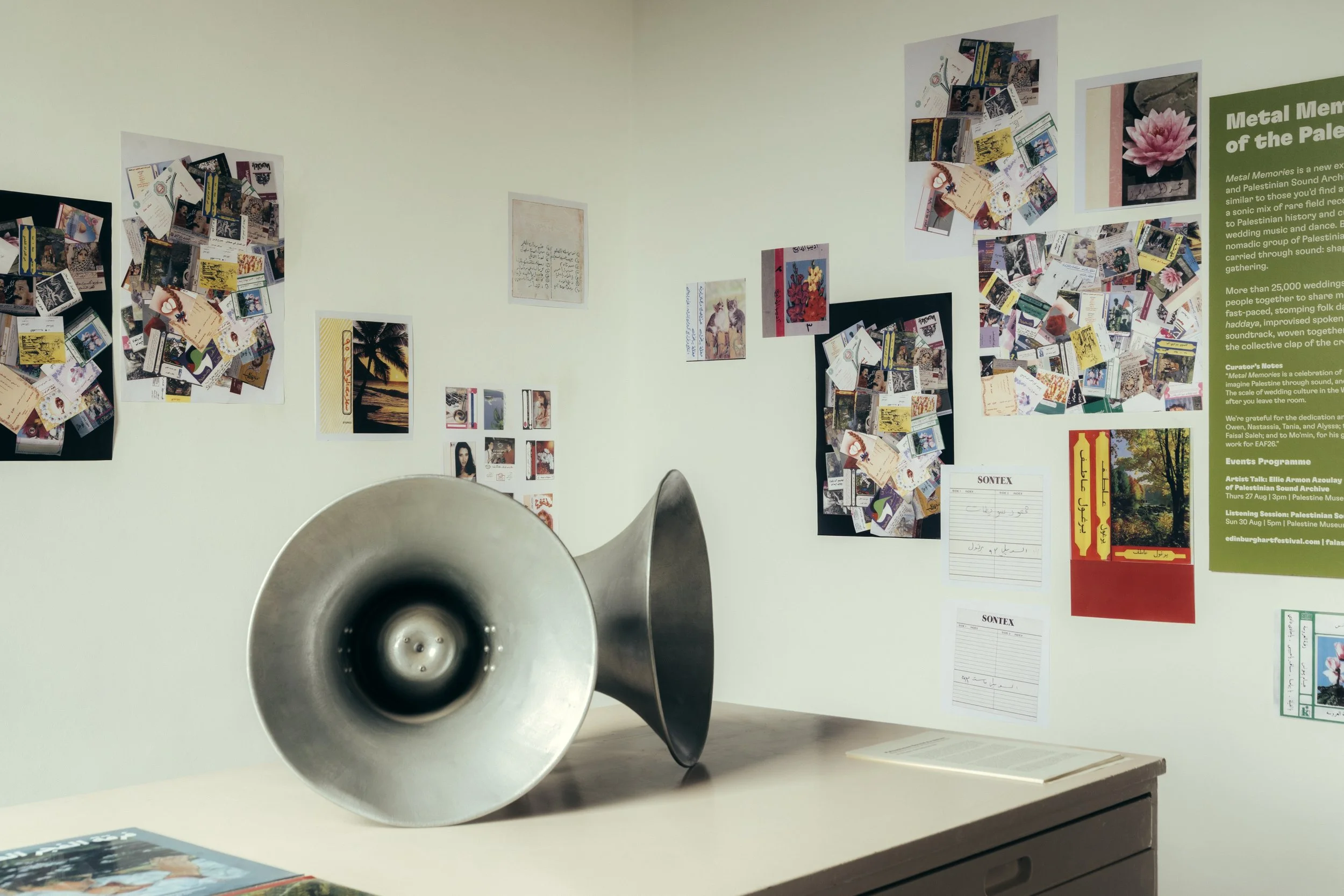
Metal Memories at the Palestine Museum, Edinburgh (2026) | Murray Orr
I have always been interested in memory. In my writing practice, I cannot divest memory from culture and inheritance. Obvious personal entry points are the iconography of La Virgen de Guadalupe whose portrait hangs in the house of all my elder family members, or the distinct food culture of my maternal northern México, or the initial burn of mezcal where my father’s side comes from on the southwestern coast. Each of these examples are layered both with meaning but also physical sensations: my ability to taste, to see, to smell what I know of being Mexican. But increasingly, the poet in me wants to know how to capture such inheritances through sound. Is this limited only to spoken language? What about street cacophony, or the sounds of the land itself? If this were possible, what sounds would be most meaningful for me?
In Metal Memories: Sounds of the Palestinian Streets, Mo’min Swaitat of Majazz Project and Palestinian Sound Archive uses field recordings, archival soundscapes and traditional music to interrogate how sound might be one of the most profound ways in which we bear witness and preserve histories. Presented at the Palestine Museum as part of Edinburgh Art Festival 2026 in collaboration with the Falastin Film Festival, the exhibition taps into sensory details so rarely given space in archival presentations. It moves beyond interviews or news sound bites by foregrounding rhythmic storytelling and folk song: musical and poetic art forms that often are deemed too parochial by ‘the academy’, or catalogued but never shown the light of day.
On a warm but grey Saturday, I find myself fighting gravity as I descend the long stretch of Hanover Street morphing into Dundas Street towards the Palestine Museum. The two young volunteers at the front greet me and point me towards Mo’min Swaitat’s exhibition, housed in a room at the back.
Somehow, even in the bright open space, the sound is not yet totally audible. Light pours through the tall windows of the B-listed building designed by Robert Reid and William Sibbald in the early 19th century, in an area of the city which was partly built off the profits derived from slavery in the Americas. The simple beauty of the building, its dark historical origins, stands in contrast to the colourful paintings and tapestries hanging from wall and ceiling.
What would these architects of the Enlightenment make of the soundscape now playing? Would they be able to understand the magnitude of their idealised New Town building housing Europe’s first museum of contemporary Palestinian art, during an ongoing genocide? I close my eyes and try to take myself back to when the building was first inaugurated over two hundred years ago. I, the grandson of immigrants, born into a land of colonial bloodshed, from a bloodline of both the oppressor and the oppressed, would never have been the ideal inhabitant of a house like this. Outside, I hear the faint rustle of trees swaying in the wind of a private garden; I feel the warmth of sun against my skin, and then the music begins to play.
In Uneasy Listening by Anouchka Grose and Robert Brewer Young, a psychoanalyst and violinmaker respectively attempt to unpack what makes a good listener. Throughout this slim volume of essays they explore the “art of listening” through theory, culture and technology. Whether listening can ever be deemed an art form is up for debate, but as Grose says, “Still, we might agree that one can distinguish between a good and bad listener, or at least good and bad listening.”
Going into this sound installation, I find myself wanting to prove I am a “good listener”. I move across the floorboards, mindful of not intruding on the experience of visitors already in the exhibition space.
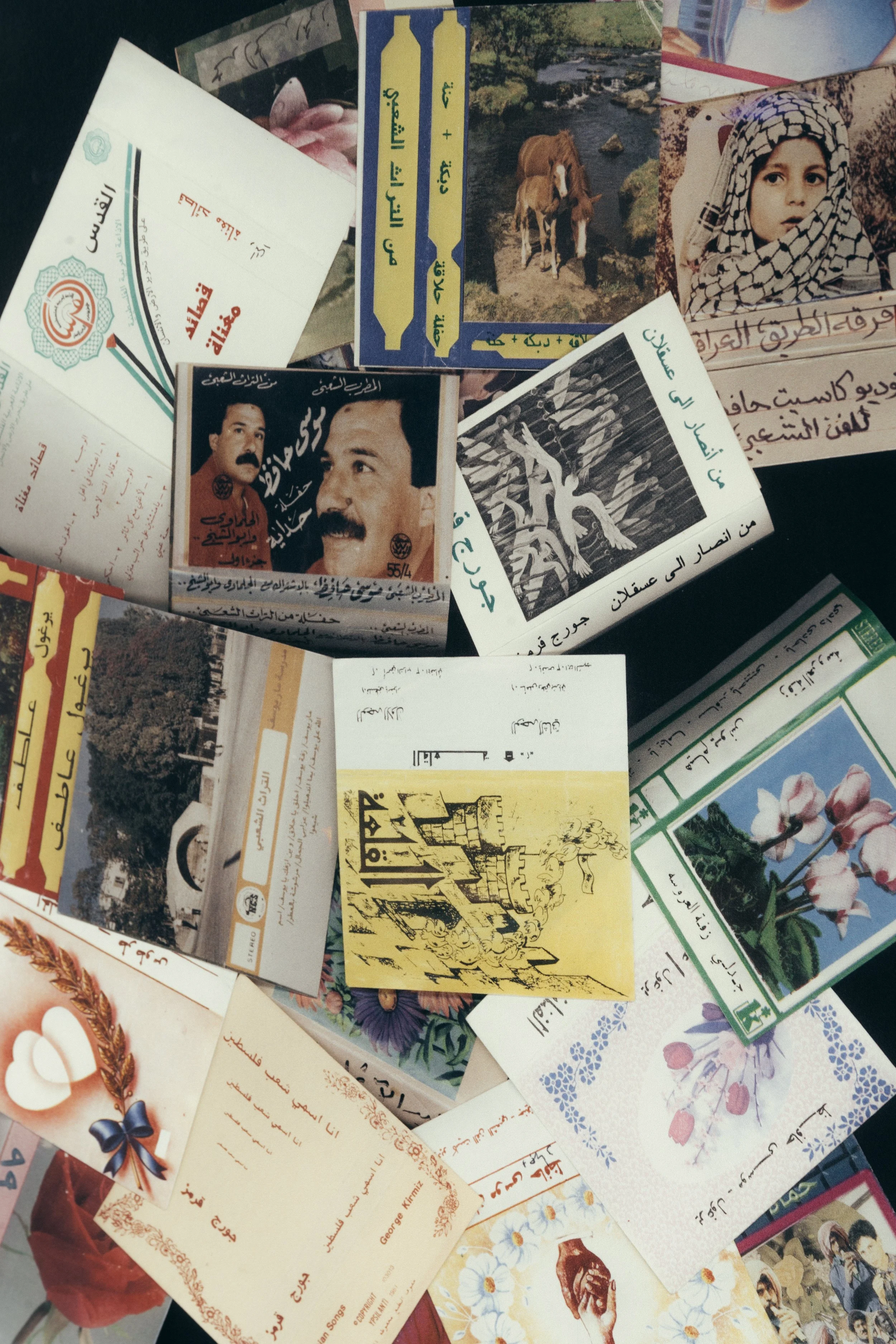
Metal Memories at the Palestine Museum, Edinburgh (2026) | Murray Orr
Sitting atop an archival cabinet are two giant metal horn speakers. I take in the fast-paced singing and music, which I later learn consists of the arghul and mijwiz – two instruments central to the music of folk dances dabka and dahiya. What I am listening to is derived from an archive of over 12,000 recordings spanning from the 1960s to 1990s: field recordings, revolutionary songs, and even the Bedouin music of Swaitat’s own family. There is a hypnotic, almost trance-like quality to the instrumentation. In certain sections, I hear the faint background noise of those watching the performance, dancing at a wedding or attending a protest. I overlay images of women in beautifully hand stitched thobe like those hanging in the other room, and young children dancing to a syncopation which reminds me of my childhood spent as a traditional Mexican folk dancer. In my mind, I replace the feeling of standing next to the North Sea at Portobello with the water’s edge of the Mediterranean in Gaza.
I open my eyes and return to this room. The walls are adorned with album covers, postcards and four drawings created by Gazan children in 2009 depicting a Palestine Red Crescent ambulance, bomber jets, and buildings on fire. It dawns on me that seventeen years have passed since these drawings were made. Where are these children now? Undoubtedly adults, have they married and participated in similar celebrations to those playing from these loudspeakers? Is what I am listening to a version of their story?
I turn around and see buses pushing uphill along the sun-drenched Edinburgh street. I close my eyes once more to take in the sounds. I may not understand the lyrics, but I can feel the emotion in each sonic movement. I want to know what the poet was thinking as he stood in front of the crowd the day this recording was made. I want to ask the happy couple what they were feeling in the lead up to their celebrations. I am curious how, in all these imagined scenarios, these people found a means of leaning into riotous joy and exuberance.
As I leave the exhibition, I am left asking myself, what are these sounds if not proof that something took place in defiant joy?
In her Booker Prize longlisted novel, Lost Children Archive, Mexican writer Valeria Luiselli explores similar territory through a family undergoing a personal crisis. Set against the backdrop of displacement and rising state violence at the US-Mexico border, her novel moves between a small family and two migrant children. The central adult couple are sound recorders and artists who travel throughout the US recording histories and people. Explaining their work, the couple ask,“[w]hen, in the future, we dig into our intimate archive, replay our family tape, will it amount to a story? A soundscape?”
As I continue to take in Swaitat’s work, it dawns on me that the story is the soundscape. The very existence of these amalgamated recordings tells me that despite rampant violence, destruction, and an attempt at eradication by the hands of Israeli settlers, the Palestinian people have long existed within a culture that is dynamic and deeply rooted in celebration. This exhibition captures the long hours of wedding celebrations, lyrical poetry so intrinsic to Arab cultures, the hypnotic playing of the mijwiz. Aspects of Palestine that don’t show up in a broadsheet’s headline or a press release from an NGO.
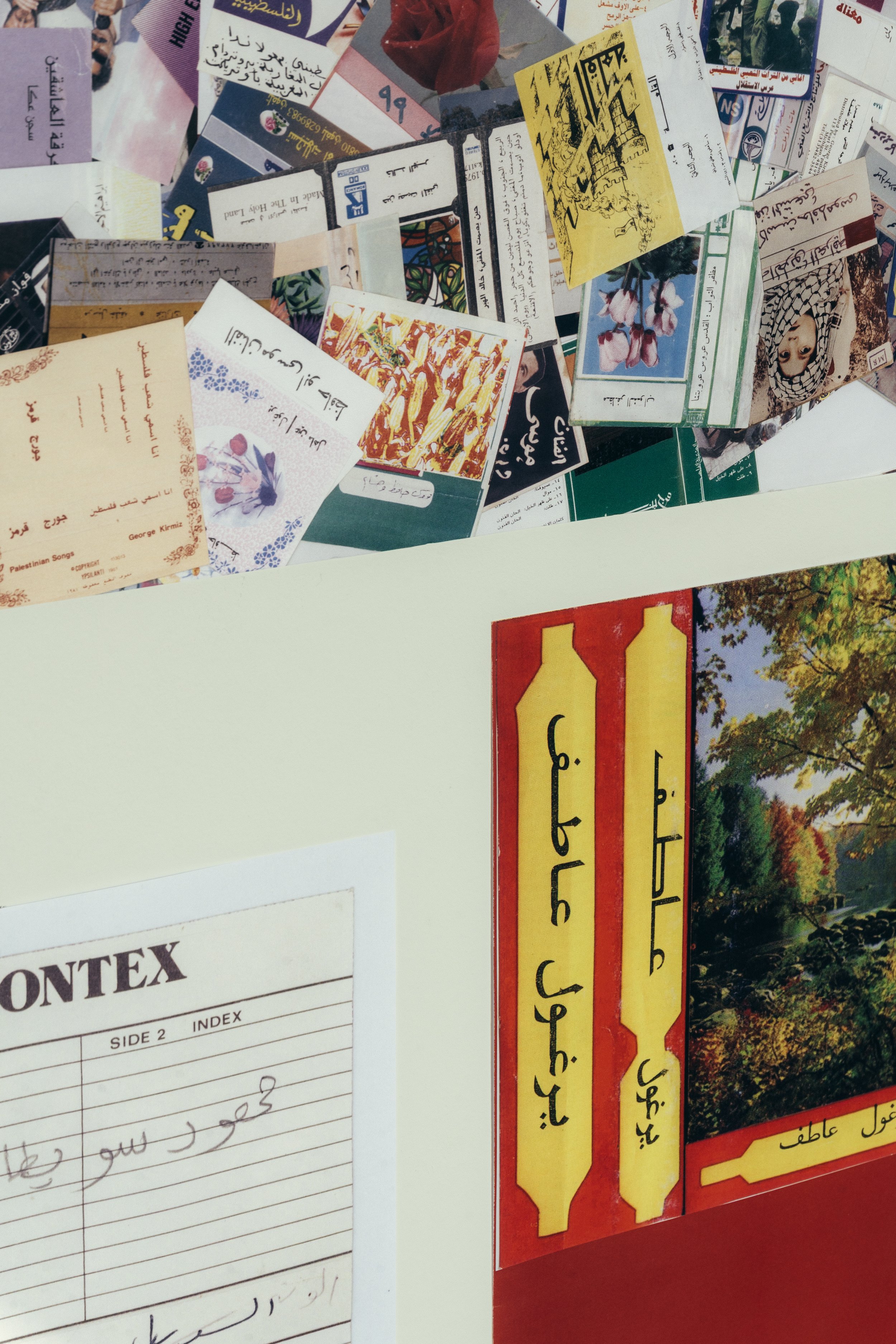
Metal Memories at the Palestine Museum, Edinburgh (2026) | Murray Orr
In Metal Memories, Swaitat highlights how the true value of any archive is determined by its ability to encompass all aspects of human existence: the heartbreak, destruction, but also multifaceted joy. Like many others living in ‘The West’, I have witnessed the horrors since October 7th 2023 from a phone, which has seen the immense destruction of Palestinian land and the loss of over 70,000 people. But what is rarely shown in a newsreel or viral video on social media is the raucous joy so very rooted in Palestinian culture. During a time of continued occupation and genocide, Metal Memories demonstrates how memory deserves to exist beyond the bounds of loss and grief. The Palestinian people are more than their history of displacement: they are a people of sensuous verse, enthralling musicality, and language that both holds room for the past and enshrines the possibility of tomorrow. I think of Randa Jarrar’s poem A Palestinian Tomorrow in which she writes:
Because today there is still a war and
maybe after the war there will be a day,
if after the war I have a drum or even a mouth
to fix to say that we will dance
and laugh so hard a day
after the day after the war
These stories of the Palestinian people are there to bear witness to, and as Jarrar says, the laughter and drumbeat surely will follow. All we need to do is allow ourselves the time and space to listen.
Metal Memories: Sounds of The Palestinian Streets; 14—30 Aug at the Palestine Museum, open daily from 11am—6pm. Part of the Edinburgh Art Festival 2026 programme.
This Response was narrated by Jess Brough, with sound editing by Sarya Wu.
