
Responding to Visitor Q (dir. Takashi Miike, 2001) at the Edinburgh International Film Festival 2026
Content notes for: sexual violence, incest, abuse, drug use, murder, violence, necrophilia, bullying.
Takashi Miike's Visitor Q depicts the maximum level of breakdown in a family. This (very) dark comedy opens on a home video sex scene between father and daughter in a seedy motel, progressing through scenes of profound dysfunction as a mysterious visitor (Kazushi Watanabe) comes to stay with the family. After the opening scene, the visitor appears and abruptly hits the father, Kiyoshi (Ken'ichi Endō), over the head with a rock (twice). We are home before this happens, where we see a mother, Keiko (Shungiku Uchida), being brutally beaten and terrorised by her own son, Takuya (Jun Mutô). The son, in turn, is subjected to horrific bullying from other students. His older sister, Miki (Fujiko) – whom we last saw having sex with her own father – has moved out, leaving her room eerily empty. We learn that Kiyoshi is out of work after a journalistic endeavor went horribly awry. Through the lens of Kiyoshi's camera, we see him attempt to interview some youths on the street and end up being raped with his own microphone. To recover his career, Kiyoshi struggles to convince his old boss to approve his new project documenting his son's experience with bullying. When she doesn't go for it, he starts working on the piece anyway, recording the bullying and commenting, "This is great."
For this family, violence and dysfunction are the natural order. Drug use, a son who beats his mother, rape, murder, bullying, sex work, and necrophilia all play a role in breaking the family down and building them back up again. Visitor Q is a body fluid extravaganza, calling up images of some of the most severe cultural taboos. In the end, the family has to free themselves, but not from the taboos. The family must free themselves from the shame these taboos incur.
Amidst the suffering we encounter in our own lives, we might ask: why watch? Why subject ourselves to narratives of rape and murder? I wouldn't exactly call Visitor Q a 'feel bad' film; in fact, the narrative arc actually seems to parody the uplifting stories of other family comedies. Murder and necrophilia bring the parents together; the acts help them understand themselves and each other. The film depicts sumptuous, if disturbing, imagery of parenthood and family. Through the lens of Kiyoshi's video camera, the film's characters look directly at the viewer, laying bare the fact that we are choosing not to turn away. We are choosing to keep watching.
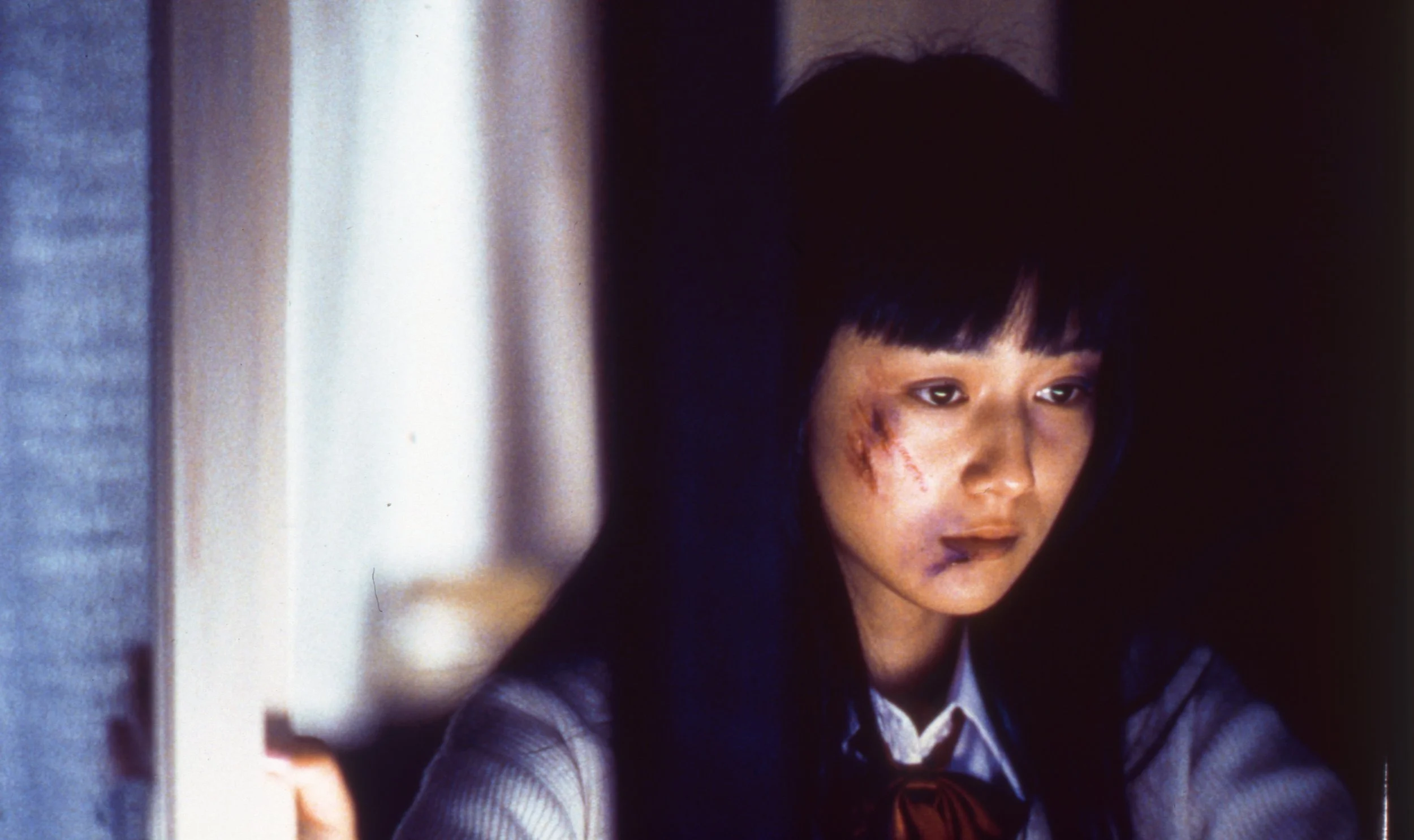
Fujiko as Miki Yamazaki in Visitor Q (dir. Takashi Miike, 2001)
Visitor Q is a difficult film, but at no point did I think to simply turn it off and walk away. I kept watching, because I felt connected to the film’s characters despite their profound flaws. Visitor Q’s characters are honest with themselves. Could I be equally honest about the fact that some part of me was titillated by what was unfolding on my screen? This is the part that prevented me from turning away in disgust, from closing my laptop and walking away. In between its moments of levity, Visitor Q tested my capacity for feeling bad about what I was watching. It looked for a reaction that goes far beyond like or dislike. We watch these complex, beautifully realised characters behave in the worst possible ways. Of course, we could perform our disgust. We could shake our heads and loudly proclaim that we would never do such a thing, that we don't approve. But who would that performance be for? Maybe it would make us feel more secure in our own moral rectitude to never view anything perverse or disgusting, but what would that do to our humanity? If I were writing this for the TikTok algorithm, this piece would be full of words like ‘grape’ and ‘unalive’. But instead I’ll say that Kiyoshi rapes and murders a woman, and I did not avert my eyes. I don’t want to please the hypothetical moral audience policing my every whim. I want to live.
Eventually, Kiyoshi comes to a realisation: "Reporting on my son's bullying has given me the opportunity to explore my feelings as a father," he says. "It wasn't anger, nor was it sadness...I was horny."
Kiyoshi owns his desires in all their fucked-up glory. To attach a moral imperative to emotion is to place a constraint on what we can feel. In depicting some of the most extreme social taboos and harms against a backdrop of family life, Miike opens the door for us as viewers to judge ourselves less harshly. In our day to day lives, we have to square ourselves with socially unacceptable emotions. The heightened version of horniness that leads the characters of Visitor Q down the roads of incest and necrophilia stand in for our own repressed horniness, maybe not for violence on such a wild scale, but for the minute versions of socially unacceptable desire that we mask on a daily basis. Visitor Q encourages us to strengthen the emotional muscles that help us withstand guilt and shame. I’m not saying that we have to act on every whim. But if we can look our desire in the eye, maybe we can be free.
This Response was narrated by Jess Brough, with sound editing by Sarya Wu.